
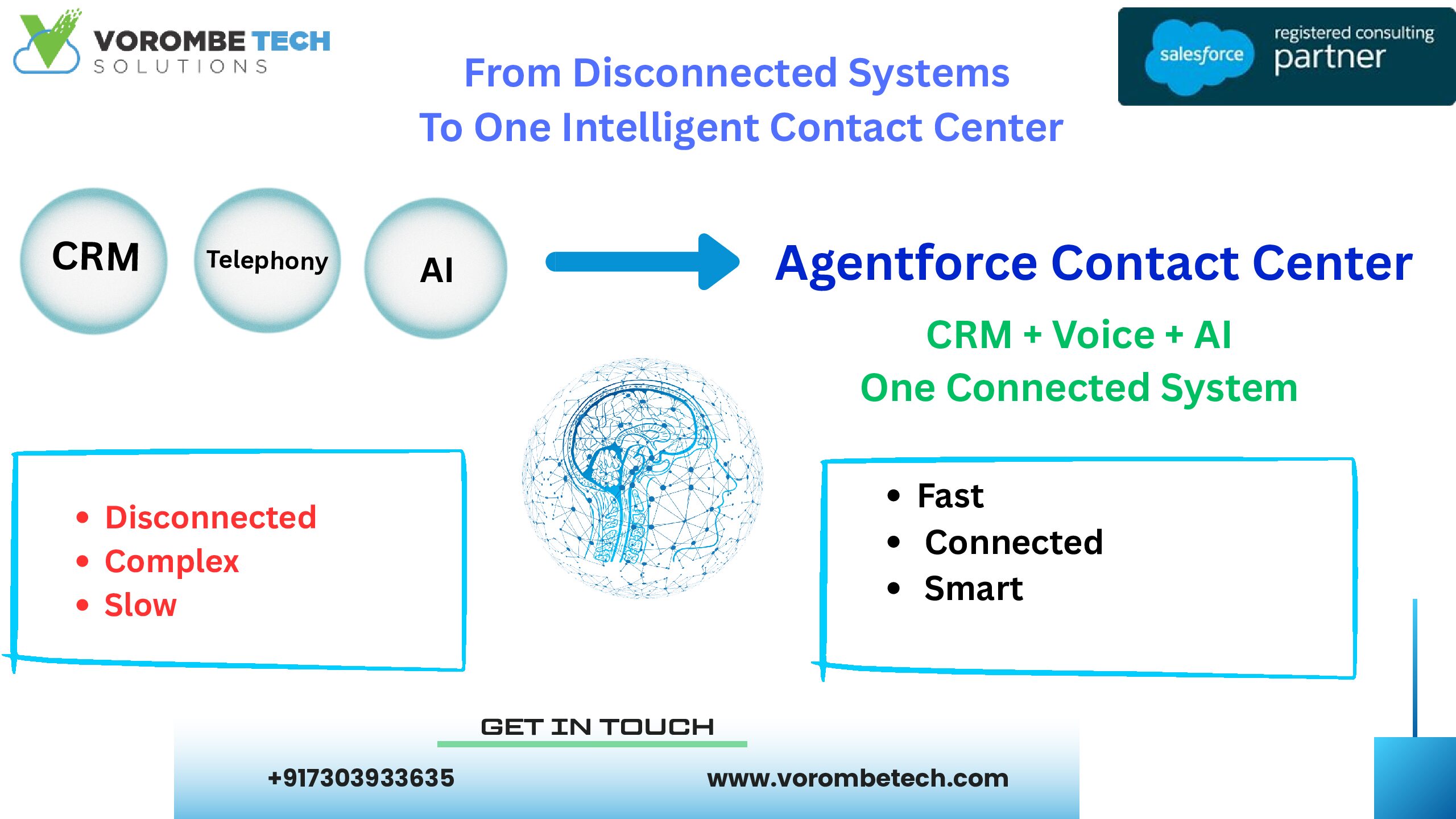
Salesforce just brought three systems into one place.
And the C CaaS market is paying attention.
It happened with Agent force Contact Center.
For years, enterprises ran three separate systems:
A CRM
A telephony platform
An AI layer
To make them work together, they paid the “integration cost.”
Custom integrations.
Duplicate data.
Disconnected workflows.
𝗔𝗴𝗲𝗻𝘁𝗳𝗼𝗿𝗰𝗲 𝗿𝗲𝗱𝘂𝗰𝗲𝘀 𝘁𝗵𝗮𝘁 𝗰𝗼𝗺𝗽𝗹𝗲𝘅𝗶𝘁𝘆 𝗶𝗻 𝗮 𝗯𝗶𝗴 𝘄𝗮𝘆.
Voice now works closely with the CRM.
Not dependent on multiple external systems.
Every conversation is:
Captured
Transcribed
Analyzed
Connected to the customer
In near real time.
This is not just a new feature.
It’s a shift.
The contact center is moving where customer data already lives.
Here is what that unlocks:
- AI handling routine queries
• Smooth AI → human handoffs with full context
• Faster setup
• One unified workspace
Early adopters are already seeing impact.
Less manual work.
Faster response.
Better prioritization.
“The most important thing in communication is hearing what isn’t said.”
Now systems can actually do that.
Sentiment.
Intent.
Context.
Available instantly — not reconstructed later.
The real shift is not growth. It is structure.
For CX leaders, the question is simple:
Do you keep managing multiple tools?
Or move to a unified, AI-driven model?
Salesforce is clearly moving toward the second.
Where Vorombetech comes in.
Most teams understand the vision.
Execution is where things break.
We help you:
Design the right architecture
Connect CRM, voice, and AI properly
Migrate from legacy systems smoothly
Make the entire setup actually work
Because the value is not in adding tools.
It is in making everything work together.
If you are exploring Agent force or contact center consolidation,
these are the decisions that matter most.


